
Financial health of Australian small businesses
A study by Zoho, 2024
Despite the rising cost of living in Australia, not all businesses are struggling equally. How are businesses coping, and what are their financial and operational concerns into the future?
We surveyed 501 business owners, founders, directors, and senior executives working in startups, sole trader businesses, partnerships, trusts, non-profits, and registered companies. This is what they had to say.

Running a business has become costlier
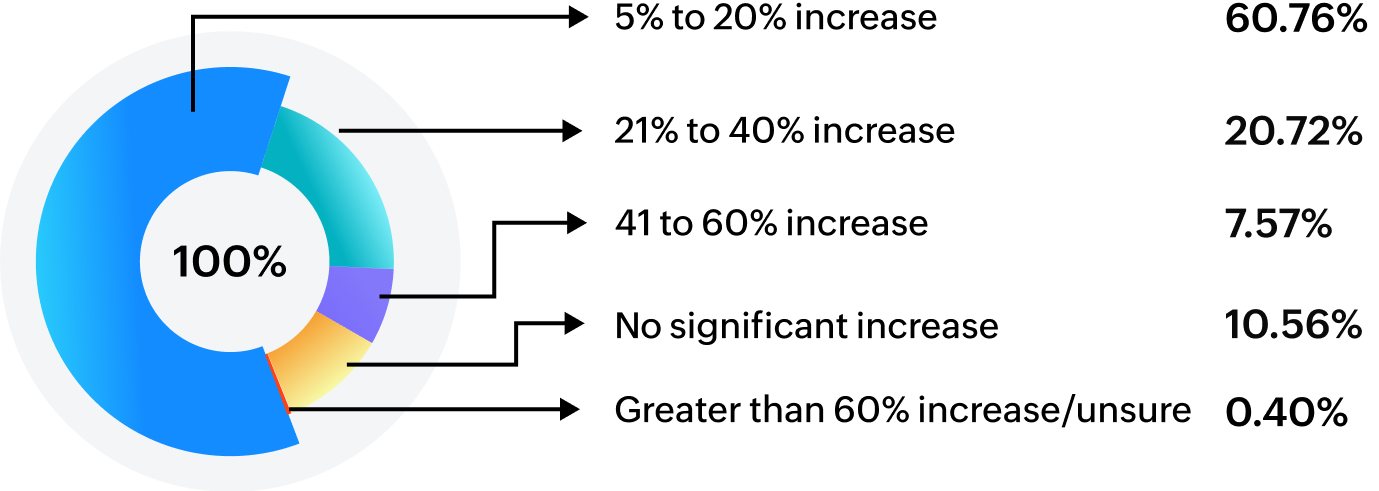
Although over 10% of our survey respondents commented that they hadn't seen a significant increase in their operational expenses in the last 12 to 18 months, over 80% of respondents were able to estimate their cost increases and highlight the causes.
Increase in the cost of running a business over the last 12-18 months, relative to revenue

Acquiring the materials necessary to run their business was the biggest cause of increased expenses for the majority of Australian businesses we surveyed. A close second was the cost of wages, while rent and utilities followed suit.
Top three factors contributing to increasing business costs, in order of most votes received
Other factors contributing to increasing costs
Utilities (30.48%), technology (30.28%), taxes, business rates and registrations (28.88%), and other miscellaneous expenses (4.18%).
Premium and luxury goods and services are in demand
Although there's constant reporting on the cost of living crisis, a significant portion of the population hasn't seen a major impact. Nationally, discretionary spends on luxury goods have consistently been on the rise over the last 5 years, reaching a record of $6.2 billion in 2023.
The impact of increased cost of living on business revenue
Essential goods and services providers
Business hasn't been impacted much
Business has been somewhat negatively impacted
Premium products and services providers
Business revenue has increased
Layoffs are the most common cost-cutting measure
Business owners are no strangers to making tough choices. Our survey revealed that even though optimism is rising again and businesses are expecting better times, they're also cautious. They haven't discounted the possibility of layoffs and internal budget cuts.
When asked about their top cost-cutting measures in case of severe hardship, for nearly 44% of Australian small businesses, letting employees go was their first option, while only 16% said that they'd first reduce the number of products or services they offered.
Nearly 31% said reducing the number of products or services they offered is a second option, while 16% said cutting back on the number of business software or licenses is their second option.
The #1 cost-cutting measure for businesses in case of severe hardship
*Respondents were given ten options and asked to rank their top 5 priorities.
Businesses want to automate more processes, work with business coaches, and keep themselves afloat
Business owners often have a range of competing priorities. While there's an undeniable need to keep the business running, leaders should also find ways to keep their operations efficient, profitable, and socially responsible. When questioned on their priorities over the next 12 months, an overwhelming majority (59.24%) said keeping their business afloat was the most important task for them. The least important, with just over 3% choosing it their number one priority, was offsetting their carbon emissions.
Nearly 10% said digitising or automating their business processes was their biggest priority, while 9% prioritised working with a business coach to achieve business goals.
The #1 priority for businesses over the next 6–12 months, ranked by number of votes
*Respondents were given ten options and asked to rank their top 5 priorities.
Aussie businesses are optimistic, but also cautious
The drop in headline inflation rates has been a welcome relief. Small businesses are optimistic and excited for what the future might bring. However, in a world more interconnected than ever before, evolving global situations have added a layer of uncertainty to businesses. While many see growth opportunities, they also remain vigilant of national and international factors that could impact their financial security.
Medium-term (3-12 months) cash flow forecast
Business forecast for the next 12-18 months
About Zoho
Zoho is a privately held technology company with over 16,000 employees across 15+ offices in the Americas, India, the Netherlands, Singapore, China, Japan, Australia, and New Zealand. Zoho offers applications in every major business category, including sales, marketing, customer support, finance, and back-office operations. Over 100 million users rely on Zoho to run their business. With over two decades of expertise in developing and implementing comprehensive business technologies, Zoho is uniquely placed to understand how the right technologies can revolutionise business operations, streamline everyday work, and enhance decision-making.

As a B2B company dealing with a variety of customer expectations and experiences daily, Zoho consistently engages with insights on emerging trends and regulatory changes and their effects on businesses. New compliance requirements, for example, may increase operational costs and affect adaptability, influencing the way small and midsize businesses invest in new technology, which in turn alters the way they manage their finances and engage with their vendors. Understanding the nuances of such business decisions allows Zoho to offer relevant, up-to-date solutions for customers.
Stay in touch
If you have any questions about this study, email us at marketing@zohoanz.com or ask us on social media: